Monday, December 29, 2025

How a Barter System Could Sustain Communities During a Supply Chain Collapse


One of the oldest forms of commerce in human society is the barter system, and it was considered the norm for a majority of human existence before the advent of currency. While it is not used as our primary method of obtaining goods and services in today’s modern society it is still alive and well in small ways through smaller groups of people, small towns, and in less developed areas of the world.

For those of us living in developed areas we rely on the supply chain to get us the goods we need, and in exchange for the currency we make while working we have access to everything we need. What happens if there is a failure in that supply chain? How do people and communities ensure they have the resources they need? The answer lies in reviving the barter systems of old and working together for the benefit of not only ourselves, but the community around us.

Before we get into how the barter system can help us, let’s take a look at how our modern supply chain works, how fragile it really is, and the many events that can lead to the collapse of the system that ensures we have access to our resources.

How The Supply Chain Works

A supply chain is defined as the network of all individuals, organizations, resources, activities, and technology involved in the creation and sale of a product. It encompasses everything from the delivery of source materials from the supplier to the manufacturer to its eventual delivery to the end user. As you can imagine, there are a lot of moving parts to make any one final product available for purchase. The steps go something like this:

  • Planning the inventory and manufacturing processes to ensure that supply and demand are adequately balanced.
  • Manufacturing or sourcing the materials needed to create the final product.
  • Assembling parts and testing the product.
  • Packaging the product for shipment or holding it in inventory until a later date.
  • Transporting and delivering the finished product to the distributor, retailer, or consumer.

Take any one step or resource out of this chain, and the chain breaks. Supply chains are complex and deeply rooted in the very existence of our society. The more we evolve into a society that relies on same- or next-day delivery, the more important the supply chain becomes. Unfortunately, that also makes us almost completely dependent on supply chains to function correctly. 

The Fragile Nature of the Supply Chain

The problem is that our supply chain is extremely fragile. The United States has learned to run on a “just-in-time” delivery system. We see it at home with our daily Amazon deliveries, sometimes arriving the same day we order them. What some might not realize is that most big-box stores operate the same way. When you walk into a Walmart around 8 p.m. on a Tuesday night and see aisles full of pallets of assorted goods waiting to be stocked, it’s because those items were ordered the night before and are ready to go on the shelves 24 hours later.

The problem with a just-in-time system is that the smallest crack in the system can instantly start to create issues. Let’s look at that from the first point in the supply chains. Raw materials. If a farmer has a drought and can’t grow wheat, how many different products does that impact the back end of our supply chain? 
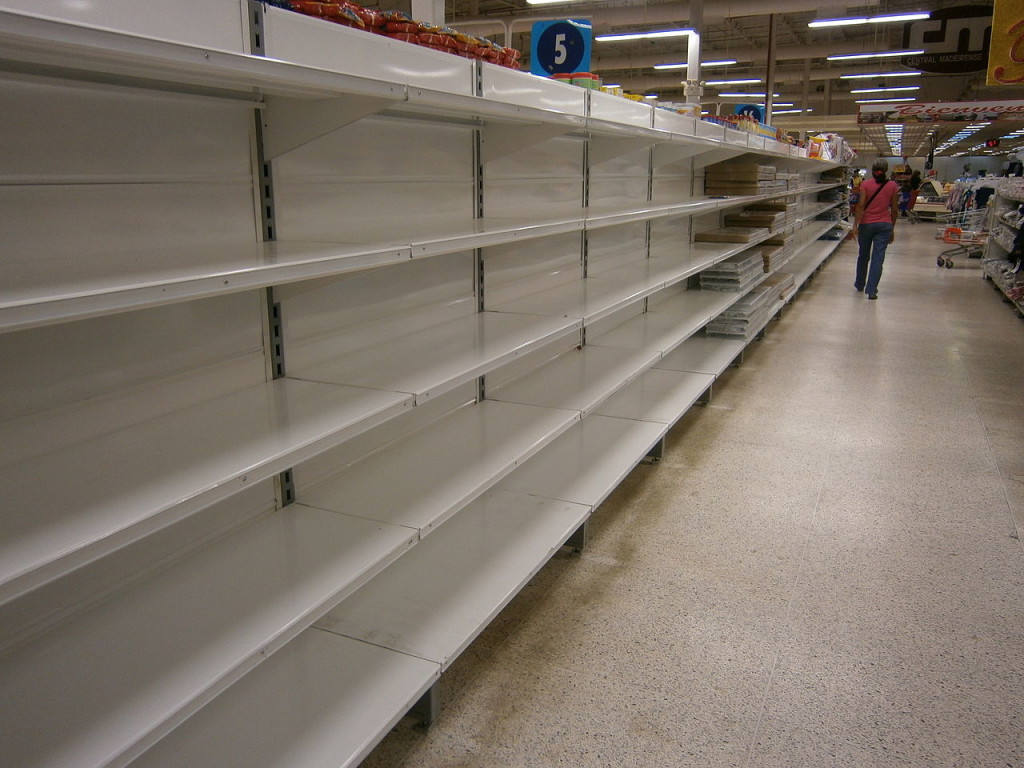
image of empty grocery shelves during a supply chain collapse

Above: Empty shelves during a supply chain collapse.

Supply Chain Failures

So, what can cause a failure in the supply chain? Just about anything. Some of the more common causes in recent years are natural disasters. We’ve been seeing a lot of weather anomalies in regions not typically known for them, such as wildfires in Canada or massive flooding from hurricanes like Katrina in 2005 or Helene in 2024.

What about snowstorms producing so much snow that travel becomes impossible? Remember the storms in the early ‘90s that pummeled the East Coast? Or the “snowpocalypse” in Texas in 2022 that essentially shut down the state because they weren’t equipped to handle such weather? What about the time an Evergreen ship got stuck in the Suez Canal in March of 2021? On March 28, at least 369 ships were queuing to pass through the canal, stranding an estimated US$9.6 billion worth of trade.

Those numbers affected the global supply chain. These are some of the more extreme examples, but this trickles all the way down to the most local level. What happens if your local pharmacy doesn’t get their delivery on time because for any number of reasons like the transport truck broke down or the warehouse lost power and now you can’t get a medication that is vital to your survival?

In some situations, roads can become impassable, infrastructure can be damaged, personnel can be impacted and the supply chain quickly decays. It’s important to note that when weather impacts a specific region, it can sometimes take months or even years for things to return to normal. 

What about issues with the workforce? A large union strike like we saw with the UPS drivers in 2023 or the International Longshoremen’s Association in 2024 or a global pandemic like we saw in 2020 can quickly cripple the people who keep the supply chain moving. Any adult today lived through the pandemic. That was unlike anything we’ve ever seen before, and we hope never to see again, but it can’t be ruled out.

It was the worst shock our supply chain has ever faced. The global economy essentially stopped, and our day-to-day lives changed drastically. Some aspects will never go back to the way they were before. Then there’s the possibility of cyberattacks or interference from a foreign country. Remember the ransomware attack on the Colonial Pipeline in 2021? These are just a few examples of what can cripple our supply chain and economy. 

How a Barter System Could Fill the Gaps 

So how do we stay ahead of these issues? What can we do to combat the vulnerabilities of a just-in-time delivery system? One answer might be to take a deeper look at a barter system. A barter system uses direct trade for goods, a practice that dates back to around 6000 BC with Mesopotamian tribes. Ancient people traded food, spices, and weapons.

In the Middle Ages, Europeans traveled across the globe to barter crafts and furs in exchange for silks and perfumes. By the time Colonial America emerged, people exchanged musket balls, deer skins, and wheat. While money eventually replaced the barter system, bartering has never truly disappeared and remains a viable system today. It may be worth revisiting more seriously. 

Benefits of Barter in Times of Crisis 

In the collapse of regular society and supply chains, it seems natural to revert to this tried-and-true system. Whether it’s a long-term or short-term problem, it’s in your interest to prepare for this before you need it. What do you have to offer? Skills, resources, or goods—what can you trade for the things you and your family need? Here are some ideas: 

  • Food and Water: Trading food products for essential services. Do you grow anything? Can you produce clean, safe drinking water? Do you have a stockpile of preserved goods? 
  • Skills and Labor: Offering skilled services (carpentry, plumbing, medical care) in exchange for tangible goods or other services. 
  • Craftsmanship and Homemade Goods: Woodworkers, tailors, and artisans exchanging handmade items for other necessities.
  • Energy and Utilities: Trading energy resources like firewood, solar-powered batteries, or fuel for essential goods. 

Bartering also offers flexibility in situations where currency loses its value. For example, in the Weimar Republic in post-World War I Germany, hyperinflation rendered money practically worthless, and citizens turned to barter for everyday needs.

Similarly, Venezuela’s currency collapse has prompted the use of bartering for food and medical supplies. This highlights the adaptability and sustainability of barter when money itself becomes unstable. 

It is also important to consider your location. While rural areas may have more access to resources like land and firewood, urban communities might adapt differently to bartering, especially with limited space.

For example, specialized skills like repair services, urban farming, or water filtration might be highly valuable in city environments. Consider building a library of skills rather than relying solely on stockpiling physical items you might not have space to store. 

Modern Examples of Barter Systems 

Bartering isn’t just a historical relic, it’s alive and well today. In Greece, which faced a severe economic crisis in the 2010s, bartering networks popped up across the country, allowing people to exchange services like teaching or home repairs for food and clothing. Similarly, in the wake of the COVID-19 pandemic, some communities turned to online barter platforms where users exchanged goods like household items or skills such as tutoring in return for essential supplies. 

As I maintain and add to my preps, I’m starting to look at things more specifically from a barter standpoint. I need to stockpile what my family needs, but also items others may find valuable. For example, I’ve invested in a still. A still can be used for a variety of purposes: making distilled beverages, essential oils, clean drinking water, and even certain medicines.

All these products can be useful to me and valuable to others for barter. I’ve also been investing in my skills. Welding, mechanics, and construction are areas that come easily to me but might be foreign to others. These skills could be valuable in a barter system. 

Challenges and Risks of Bartering 

Does currency have a place in a barter system? Absolutely, but it might not look the same. Currency could be made up of precious metals, similar to our first coins, or even bullets—how many .22L rounds would equal a “dollar”? Establishing value is one of the challenges of a barter system. Determining equal value between goods and services can be difficult.

Would you stitch up a leg wound for a loaf of bread? How many chickens is a running motorcycle worth? Perishability is another factor to consider, as some goods like food can spoil and may not be suitable for long-term bartering.

If you are proficient in food preservation maybe you can take tomatoes that would normally only last a few weeks and jar them, so they are shelf stable almost indefinitely. Additionally, bartering tends to work best in tight-knit or local communities where trust and mutual understanding are high.

Modern technology offers digital and modern adaptations to bartering. Peer-to-peer barter apps and digital platforms like social media groups or local online forums facilitate trade in real-time. Facebook Marketplace already serves as a place where people can network and barter. However, in a grid-down situation, these digital options may not be available.

Taking Action to Build Barter Systems Now 

What steps can you take to implement a barter system in your community? First, identify your resources and skills. Encourage individuals and families to assess what they can offer. Next, set up physical or digital places where people can meet and discuss potential trades. Barter markets or swap events can foster community participation.

Establishing barter meetups now would allow your community to get used to the system and feel comfortable with the concepts. It may also be important to develop a loose set of guidelines to ensure fairness, safety, and efficiency. Doing this now, before a crisis occurs, can be hugely beneficial to you, your family, and your community. It’s always easier to have a system in place before disaster strikes than to implement it afterward.

Bartering might not be the be-all and end-all of survival strategies, but it fits into a larger strategy for self-reliance and resilience. Bartering alone may not solve all problems, so complementing it with other preparedness measures like learning how to grow food, purify water, or generate energy independently can help you become more self-reliant overall. 

I’m a firm believer that a rising tide raises all ships, and while it’s important to build a strong community of like-minded and capable people, that journey starts in your own home. Making you and your family as prepared as possible is just the beginning.

The goal should be to create a network of self-reliant individuals, each with something valuable to offer. Bartering can be a key part of that larger picture of resilience, but it’s the combination of preparation, skill-building, and resource management that ultimately sustains communities when the unexpected occurs.

Final Thoughts 

In the end, having a system like barter in place doesn’t just help ensure access to vital goods and services during a crisis—it fosters a sense of connection and cooperation. When the grid goes down or supply chains collapse, people will naturally turn to one another for support. Being prepared for that moment, both individually and as a community, could make all the difference.

The sooner we begin these conversations and take action, the better equipped we will be to face whatever challenges the future might hold. Whether through learning new skills, gathering valuable resources, or building trust in local networks, we have the opportunity to strengthen our communities and enhance our overall resilience, starting right now.

Quick Reference to Common Barter Goods

Stockpiling goods, the ability to grow or raise your own food, and having some basic skills can put you in a great position during any emergency situation that results in a collapse of the supply chain. Having some extra stock and the willingness to lend your skills to others can enable you to barter with others in the community and not only survive but thrive!

Here are some commonly barterable goods and services with some examples in each category. This far from an exhaustive list, but should be enough to get your wheels turning:

  • Canned Food: Vegetables, Meat, and Tuna Fish.
  • Dried Food: Rice, beans, and pasta.
  • Clean Water: Bottled water and filtration systems.
  • Baby Supplies: Diapers, clothing, and shelf stable formula.
  • Weather Related Gear: Raincoats, winter clothing, and umbrellas.
  • Building Materials: Plaster, Paint, and lumber.
  • Hygiene Items: Toothpaste, soap, and deodorant.
  • Batteries: AA, AAA, C, and D cell.
  • Precious Metals: Silver and gold coins.
  • Footwear: Sneakers, work boots, and weather specific footwear
  • Fresh Produce and Meat: Grow produce and Raise Livestock.
  • Tools: Hammers, saw blades, screw drivers, and cutting tools.
  • Hardware: Screws, nails, and washers.
  • Comfort Items: Blankets, pillows, games, books, and liquor.
  • Common Medication: Tylenol, Advil, cold medication, and allergy relief.
  • First Aid Supplies: Bandages, Sutures, disinfectants, and gauze.

Barter Skills

  • Automotive Repair Skills
  • Cooking Skills
  • Sewing and Tailoring
  • “Handyman” and Maintenance Skills
  • Plumbing, Construction, and Building Skills
  • Medical and First Aid Skills
  • Teaching and Education Skills
  • Crafting Skills
  • Foraging Skills
  • Farming and Livestock Skills
  • Pest animal and Wildlife Management Skills
  • Electronic Device Repair Skills
  • Home Cleaning Skills
  • Child Rearing and Supervision Skills
  • Landscaping Skills
  • Gunsmithing Skills
  • Metalworking Skills

Featured Barter Items: Ammunition and Firearms Parts

Ammunition is a vital resource that is often overlooked when it comes to bartering. Firearms give us the ability to defend our homes and loved ones, as well as allow us to put food on the table if we live in a rural area and have hunting skills. Unfortunately, they are pretty ineffective without ammunition or if common wear and tear parts deteriorate due to lack of maintenance or heavy use.

Keeping a good stock of commonly used ammunition can not only ensure you will not run out, it can also provide you a very in demand commodity that less prepared individuals will be seeking to provide them with a sense of security and a means of feeding themselves and their loved ones. Companies like Black Hills Ammunition can keep you well-stocked on high-quality handgun ammo and top of the line self defense and hunting rifle rounds.

When it comes to Firearms, parts will wear out through time and use. This is especially prevalent with one of the most commonly owned platforms, the AR. one of the primary advantages of the AR platform is the ability to easily maintain, repair, and replace nearly every part with just a few simple tools.

It is expected that parts like buffers, springs, firing pins, bolt carrier groups, charging handles, optics, and even barrels will need to be replaced with extended use. Having a good stock of high quality parts like the ones found at Bravo Company Manufacturing will keep your AR platform operating at peak performance for years, and provide you with ultra high value bartering items during an extended supply chain crisis.

I also invite you to take a look at this site- www.whatfinger.com

Friday, December 26, 2025

The Only People Your Government Is Comfortable Killing Are You


“Flee the People” is not a slogan. It is a description of behavior, and of the incentives that make that behavior rational.

Across the country, citizens are voting with their feet. They leave cities where crime is tolerated and law enforcement is paralyzed. They leave school systems that no longer educate. They leave regulatory environments that punish independence. They leave institutions that demand loyalty while offering no protection in return.

Census data, real estate migration patterns, and tax base shifts all tell the same story. IRS and Census Bureau data from 2020 through 2024 show sustained net domestic outmigration from high-tax, high-crime states, with California, New York, and Illinois leading the losses. People with the means to exit are doing so. They are not leaving because they dislike diversity, democracy, or modernity. They are leaving because the basic bargain of citizenship has eroded.

That bargain was never perfect, but it was understood. In exchange for taxes, obedience to law, and civic participation, the state provided a reasonable level of protection, stability, and opportunity. That exchange is now asymmetric.

Citizens are expected to comply, fund, and affirm. In return, they are offered explanations, not results. When harm occurs, they are told it is complicated. When they object, they are told they are the problem.

This is why flight has become rational.

Some flee geographically. They move to jurisdictions with lower taxes, stronger enforcement, or fewer mandates. Others flee institutionally. They withdraw from civic life, avoid public spaces, and disengage from politics. Still others flee psychologically. They stop trusting official narratives, limit exposure, and operate quietly beneath the surface.

The arrangement absorbs this flight with indifference.

Those who leave are replaced. Labor is imported. Automation advances. Social cohesion weakens, but throughput continues. The departure of high-trust citizens does not trigger reform. It triggers adjustment.

This tells us something important. A government that truly depends on its people cannot afford to lose them. A government that treats people as interchangeable inputs can.

At that point, citizenship ceases to be a mutual relationship. It becomes a conditional status, valuable only insofar as it does not impose demands on the system that administers it. “We the People” assumes ownership and obligation. “Flee the People” describes a country that has quietly decided it no longer needs either.

The Hierarchy of Harm

Every society enforces rules selectively. That is unavoidable. Resources are finite, time is limited, and no legal system can pursue every offense with equal intensity. What matters, then, is not whether selectivity exists, but where it consistently falls.

Over time, patterns emerge.

In the United States, violent crime offers a clear example. FBI Uniform Crime Reports and Bureau of Justice Statistics data have shown for decades that a relatively small number of repeat offenders account for a disproportionate share of serious violence. This is not a controversial finding. It has been replicated across cities, decades, and political administrations. Yet the policy response has moved steadily away from incapacitating those offenders and toward managing the damage they cause.

District attorneys in major cities openly decline to prosecute entire categories of crimes. Cash bail is eliminated for repeat offenders. Sentences are reduced. Violent criminals cycle through the system with remarkable speed. When the consequences arrive, they arrive where they always do, on ordinary people living in ordinary neighborhoods.

The response to this violence is almost always the same. More studies. More task forces. More explanations about root causes. The harm is handled as tragic, complex, and regrettable, but rarely urgent.

Now compare that with how the system responds to challenges of a different kind.

Speech that questions dominant narratives is met with speed and coordination that violent crime rarely receives. Social media platforms adjust algorithms. Financial services terminate accounts. Employers are pressured to sever ties. Federal agencies issue warnings about misinformation, extremism, or threats to democracy. The response is not tentative. It is decisive.

The contrast is difficult to ignore. Ideas are framed as emergencies, while physical harm is treated as a social condition. One triggers immediate action. The other triggers endless discussion.

A lack of information cannot explain this difference. The data on crime is public. The victims are visible. The costs are measurable in lost lives, lost productivity, and communities hollowed out by fear and retreat. If the system wanted to respond aggressively, it could. It has done so in the past.

Instead, it chooses not to.

What provokes urgency is not suffering, but disruption. Not injury, but disobedience. Not death, but loss of narrative control.

This hierarchy reveals itself again and again. Citizens are told that safety requires patience, nuance, and restraint. But dissent is treated as an immediate threat requiring swift containment. Violence is contextualized. Speech is criminalized. One is absorbed. The other is hunted.

None of this requires a secret meeting or a unified plan. Incentives do the work. Officials who crack down on violent criminals are accused of cruelty. Officials who crack down on speech are praised for responsibility. One carries political cost. The other carries institutional reward.

Over time, systems adapt to what is rewarded.

The result is a hierarchy of harm that no longer aligns with the stated purpose of government. The system responds fastest to whatever threatens power, legitimacy, or control. It responds slowest to whatever merely harms citizens.

That hierarchy is the foundation for everything that follows.

Killing Without Pulling the Trigger


For most of history, the word killing referred to a narrow set of actions. Violence was direct. Responsibility was visible. Someone pulled a trigger, swung a blade, or dropped a bomb. Cause and effect were obvious, and so was accountability.

Modern states do not operate that way. They do not need to.

In advanced bureaucratic systems, harm no longer requires force. It requires exposure. Delay. Neglect. Dependency. The slow accumulation of conditions that shorten life, weaken health, and erode judgment while remaining just diffuse enough to avoid blame.

This is not a semantic trick. It is a structural shift.

Consider how policy-induced harm is typically discussed. When citizens die from violent crime, the deaths are counted, mourned briefly, and then folded into broader social explanations. When citizens die from medical complications tied to approved treatments, those outcomes are labeled rare, anecdotal, or unrelated. When chronic illness rises alongside industrial food systems and chemical exposure, the blame is shifted to lifestyle choices. When despair drives suicide and addiction, the cause is described as cultural, not political.

In each case, the result is the same. The harm is real, measurable, and persistent, but responsibility dissolves into abstraction.

Bureaucracies are particularly good at this. A policy can shorten millions of lives by small increments without ever appearing lethal on paper. Life expectancy can stall or decline while agencies continue to describe progress. Excess deaths can rise while officials argue over definitions. No single decision appears fatal. The cumulative effect is.

In the United States, life expectancy declined for several consecutive years leading into the 2020s, even before the pandemic effects were fully accounted for. Chronic disease rates continued to rise. Drug overdose deaths surpassed one hundred thousand annually. These are not edge cases. They are population-level failures.

Yet these outcomes rarely provoke the kind of urgency reserved for institutional threats. There are no emergency powers to address ultra-processed food. No sweeping interventions against environmental chemical exposure. No rapid reforms to medical incentive structures that reward treatment over prevention. The damage continues, quietly.

This is what killing looks like in a system that prefers deniability.

The harm is distributed across agencies, industries, and time horizons. Responsibility is fragmented. Each institution can plausibly claim that the problem lies elsewhere. Regulators point to manufacturers. Manufacturers point to consumers. Politicians point to complexity. Complexity becomes the shield.

The distinction between intent and outcome matters here, but not in the way it is usually framed. A system does not need to intend death to produce it reliably. It only needs to tolerate the conditions that make death more likely and refuse to correct them when correction is politically inconvenient.

At that point, indifference becomes operationally indistinguishable from intent.

When preventable harm is known, persistent, and documented, the refusal to act is no longer neutral. It is a choice. And when that choice is made repeatedly, across administrations and decades, it becomes policy.

This is why the language of safety rings hollow to so many people. They are told that every intrusion is justified to protect life, even as life outcomes worsen. They are asked to accept restrictions, mandates, and surveillance in the name of health and security, while the most obvious sources of long-term harm remain untouched.

What is being protected, then, is not life in general. It is the system’s freedom to operate without disruption.

Killing without pulling the trigger is not an aberration of modern governance. It is one of its most reliable tools. It allows harm to accumulate without confrontation. It allows responsibility to vanish into process. And most importantly, it allows the state to maintain the language of compassion while accepting outcomes that would have been intolerable in any earlier era.

Once that framework is in place, the rest follows naturally.

Physical Harm as Acceptable Collateral

Once harm is reframed as indirect and responsibility is diffused, the threshold for accepting physical damage drops sharply. Death does not need to be denied. It only needs to be explained away.

This is where the language of “tradeoffs” enters. Costs are acknowledged, but always in the passive voice. Lives are lost, but no one loses standing. The harm is real, but it is framed as unavoidable, unfortunate, or necessary.

War provides the clearest example.

For decades, American citizens have been sent into conflicts that were never formally declared, never clearly defined, and never meaningfully concluded. Young men, drawn disproportionately from working-class backgrounds, are asked to risk death for objectives that shift constantly and are rarely measured against outcomes. When those wars fail, the language changes. Mistakes were made. Intelligence was flawed. Lessons were learned.

The dead remain dead.

What is striking is not simply that war kills. That has always been true. What is striking is how little accountability follows wars that produce no durable benefit for the people who paid the cost. Trillions of dollars pass through defense contracts, reconstruction efforts, and foreign aid pipelines, while veterans return to understaffed hospitals, rising suicide rates, and a bureaucracy that treats their injuries as paperwork problems.

This is not a system struggling to prevent death. It is a system that has learned how to absorb it.

The same logic appears in public health, though it is rarely discussed in those terms.

Modern medicine excels at acute intervention. It is less effective and often uninterested in prevention. The financial incentives are not subtle. Chronic conditions generate steady revenue. Long-term treatment is billable. Cures are not.

As a result, Americans face rising rates of obesity, diabetes, autoimmune disorders, and metabolic disease despite unprecedented medical spending. According to data from the CDC and OECD, the United States spends far more per capita on health care than comparable countries, yet consistently ranks worse on basic health outcomes. Life expectancy stagnated and then declined even before COVID-19 distorted the numbers.

These outcomes are treated as lifestyle failures rather than policy failures. The food supply grows more industrialized. Chemical exposure increases. Ultra-processed foods dominate diets. And yet the burden of responsibility is placed almost entirely on individuals, even as regulatory systems protect the industries that shape those choices.

Environmental exposure follows the same pattern.

Americans are exposed daily to substances that did not exist in meaningful quantities a century ago. PFAS compounds, microplastics, endocrine disruptors, and industrial runoff are now routinely detected in water, soil, and human blood samples. These exposures correlate with rising rates of cancer, infertility, and developmental disorders.

None of this is secret. Government agencies publish the data. Scientific journals document the risks. But meaningful intervention remains slow, partial, and easily stalled by industry pressure. The damage accumulates quietly while regulators debate thresholds and timelines.

In each case, the same logic applies. The harm is real. The victims are visible. The solutions are politically costly.

So the machinery keeps moving by normalizing the loss.

Deaths become statistics. Illness becomes prevalence. Exposure becomes background. Responsibility becomes a matter of personal choice or unfortunate complexity. The cumulative effect is physical harm on a massive scale, absorbed year after year without triggering the kind of urgency reserved for institutional threats.

This is what acceptable collateral looks like in a modern administrative state. Not mass executions or open brutality, but a steady tolerance for outcomes that shorten lives and degrade health, so long as those outcomes do not threaten the structure that produces them.

Once that tolerance is established, weakening the population becomes not a side effect, but a predictable result.

Managed Weakening of the Population

Physical harm alone does not guarantee compliance. Injured populations can still resist. History is full of examples where hardship produced rebellion rather than submission. What makes modern systems different is not the presence of harm, but the way weakness is cultivated alongside it.

A population that is tired, distracted, medicated, indebted, and demoralized is far easier to govern than one that is healthy and confident. That reality does not require sinister intent. It follows naturally from incentives that reward short-term stability over long-term strength.

Education is an obvious starting point.

For most of American history, public education was explicitly designed to produce literacy, numeracy, and civic competence. Over time, that mission blurred. Standards declined. Discipline was reframed as oppression. Objective assessment gave way to subjective validation. The result has been measurable. National Assessment of Educational Progress data show long-term stagnation and recent declines in reading and math proficiency, particularly among lower-income students who have the fewest alternatives.

Instead of confronting this failure directly, the system increasingly treats it as a matter of equity language and administrative reform. More funding flows to bureaucracy. Less attention is paid to outcomes. Students who struggle are medicated rather than challenged. Expectations are lowered in the name of compassion. The effect is not empowerment. It is dependency.

Psychological weakening follows the same pattern.

Rates of anxiety, depression, and loneliness have risen sharply, especially among younger Americans. The CDC and Surgeon General have both acknowledged a mental health crisis, particularly among adolescents. At the same time, the digital environment has become more immersive, more addictive, and more carefully engineered to capture attention.

Pornography, social media, and algorithmic entertainment systems are not neutral technologies. They are designed to exploit predictable neurological responses. Dopamine loops replace sustained focus. Stimulation substitutes for purpose. Isolation is reframed as personalization.

This environment does not produce resilience. It produces fragility.

When people struggle under these conditions, the response is rarely to change the system that profits from their dependence. Instead, the individual is treated. More prescriptions. More diagnoses. More accommodation. The underlying structures remain intact.

Economic exhaustion completes the picture.

Inflation quietly erodes purchasing power year after year. Debt becomes a permanent feature of adult life. Housing costs rise faster than wages. Licensing regimes and regulatory barriers make independent enterprise increasingly difficult. According to Federal Reserve data, a significant percentage of Americans cannot cover a modest emergency expense without borrowing.

This is not accidental. Monetary systems that rely on continuous expansion benefit from a population that consumes, borrows, and remains dependent on centralized institutions. Inflation functions as a tax that does not require legislation. Debt functions as restraint without bars.

The combined effect of educational decline, psychological fragility, and economic pressure is predictable. People become less willing to take risks. Less able to think long-term. Less inclined to challenge authority. Survival absorbs attention that might otherwise be spent on civic engagement or resistance.

A strong population asks difficult questions. A weakened one asks only for relief.

None of this requires coordination across agencies or decades. Each institution pursues its own incentives. Schools avoid conflict. Tech companies maximize engagement. Financial systems reward leverage. Healthcare systems treat symptoms. Politicians manage optics.

The outcome, however, is coherent.

A population that is constantly exhausted is not one that needs to be coerced. It will regulate itself. It will trade liberty for stability. It will accept explanations it would once have rejected.

Weakness becomes governance infrastructure.

Law as an Instrument of Discipline


Law is supposed to be the great equalizer. In theory, it restrains the strong and protects the weak. In practice, it reflects priorities. What is enforced aggressively matters. What is ignored matters just as much.

Over the past several decades, the American legal system has grown increasingly selective, not in subtle ways, but in ways that are visible to anyone paying attention.

At the same time, enforcement in other areas has become relentless.

Speech that challenges dominant political narratives is scrutinized intensely. Federal agencies issue guidance on misinformation and extremism. Financial institutions quietly deny services. Employers are pressured to terminate dissenters. Social platforms remove accounts, suppress reach, or apply warning labels. None of this requires new laws. It operates through informal coordination, regulatory leverage, and reputational pressure.

The contrast is stark.

A violent offender may be treated as a victim of circumstance. A citizen who speaks out of line is treated as a threat. One receives patience. The other receives punishment.

This inversion is not confined to speech. It extends to compliance more broadly. Regulatory enforcement falls hardest on small businesses and individuals least able to navigate complex rules. Large institutions negotiate. They settle. They pay fines that function as operating costs. Smaller actors are crushed.

The law, in other words, no longer functions primarily as a boundary on power. It functions as a management tool.

This is not new in principle. What is new is the scale and asymmetry. Digital systems allow enforcement to be fast, targeted, and largely invisible. A bank account can be frozen without a trial. An online presence can be erased without due process. A career can be ended without formal charges.

Meanwhile, the harms that most directly shorten lives receive comparatively little urgency.

This is the point at which explanations about incompetence stop being persuasive. A system that consistently enforces rules against dissent while declining to enforce them against violence is not confused. It is calibrated.

The message is clear, even if it is never stated outright. Physical harm is tolerable if it does not threaten authority. Disobedience is intolerable even if it harms no one.

Once law is used this way, weakness becomes permanent. Citizens learn quickly which behaviors are safe and which are dangerous. Silence becomes rational. Conformity becomes self-preservation.

At that stage, enforcement no longer needs to be widespread. A few examples suffice. The rest of the population adjusts accordingly.

Law, stripped of its moral foundation, becomes something else entirely. It becomes a mechanism for discipline rather than justice.

And once that transformation occurs, control no longer requires force. It requires only consistency.

Control Without Chains

Once a population learns which behaviors are punished and which are ignored, overt force becomes unnecessary. Control becomes quieter, cheaper, and far more effective. The goal is no longer to restrain bodies, but to shape behavior in advance.

Modern surveillance systems make this possible in ways previous regimes could only imagine.

Most Americans now carry devices that track location, movement, communication, purchases, and associations. This data is collected continuously, aggregated, and analyzed, often by private companies but increasingly in coordination with government agencies. The arrangement is framed as a trade. Convenience in exchange for data. Safety in exchange for privacy.

The trade is rarely revisited once accepted.

Digital identity systems expand naturally from this foundation. What begins as account verification becomes credentialing. What begins as fraud prevention becomes access control. Participation in economic and social life grows increasingly dependent on compliance with opaque rules enforced by algorithms rather than courts.

Cashless payment systems accelerate the process. Physical currency allows transactions without permission. Digital systems do not. They create permanent records, enable instant intervention, and allow behavior to be rewarded or punished automatically. Access can be restricted without accusation, explanation, or appeal.

This is not speculation. Financial institutions already freeze accounts for suspected violations of terms of service. Platforms already restrict speech through automated moderation. Governments already pressure private companies to enforce policies they could not impose directly.

The effect is behavioral.

When people know they are being watched, they adjust. They avoid controversial topics. They self-censor. They disengage from public debate. Surveillance does not need to be constant to be effective. It only needs to be possible.

What makes this form of control so powerful is that it rarely feels like coercion. There are no police at the door. No visible punishment for most people. Life continues normally for those who stay within the boundaries. Those who cross them discover how quickly systems can close.

This arrangement also solves a political problem. Enforcement becomes deniable. Officials can claim that private companies, automated systems, or neutral standards made decisions. Responsibility is outsourced. Power remains intact.

In earlier eras, control required spectacle. Public trials. Visible repression. Those methods produced resistance. Modern systems do the opposite. They make compliance that feels voluntary.

People begin to police themselves, choosing silence over risk, consumption over participation, and personal comfort over collective action. Over time, the range of acceptable thought narrows, not through law alone, but through habit.

A population that self-censors does not need to be threatened. It does not need to be convinced. It simply needs to be monitored.

Control without chains is not a future possibility. It is already the default operating mode of modern governance. And once it is established, reversing it becomes extraordinarily difficult.

At that point, the question is no longer whether citizens are free in theory, but whether freedom remains usable in practice.

The Citizen Reclassified

When physical harm is tolerated, weakness is managed, law is selective, and surveillance is constant, something fundamental changes. The citizen is no longer treated as the reason the system exists. He is treated as an input.

This shift is easiest to see in how public finance now operates.

Taxes are no longer primarily associated with clear public goods. They service debt. According to Treasury data, a growing share of federal revenue goes not to infrastructure, safety, or shared investment, but to interest payments on obligations accumulated over decades. Citizens pay, not for improvement, but to maintain solvency.

Inflation compounds the effect. It quietly erodes savings, wages, and fixed incomes without a vote or a bill. The Federal Reserve describes this as a necessary tool of economic management. In practice, it functions as a regressive tax that falls hardest on those with the least ability to hedge. Those closest to financial systems adjust. Those farthest from them absorb the loss.

Regulation completes the reclassification.

Complex licensing regimes, compliance costs, and reporting requirements fall unevenly. Large corporations absorb them as operating expenses. Small businesses struggle or disappear. Independent livelihoods give way to salaried dependency. Risk concentrates upward. Control follows.

None of this looks like traditional domination. There are no chains. There are contracts. Terms of service. Compliance frameworks. Forms. Dashboards. Income. Credit score. Health metrics. Risk profile. Social footprint. These abstractions are easier to manage than people. They allow decisions to be made at scale, without moral friction.

Once citizens are reduced to metrics, their replacement becomes conceivable. Labor is imported. Automation is deployed. Communities dissolve. Loyalty becomes irrelevant. Participation is optional so long as extraction continues.


This is where the subtitle of this essay becomes literal.

A country organized around We the People assumes mutual obligation. Rights imply duties. Citizenship implies protection. A country organized around Flee the People does not need attachment. It can tolerate exit. In some cases, it quietly encourages it.

High-trust citizens who ask questions, resist narratives, or refuse compliance become costly. They slow processes. They demand justification. They expect reciprocity. Systems built for throughput do not value friction.

So people leave. They withdraw from cities. From institutions. From civic life. From participation itself. Some leave geographically. Others leave psychologically. They disengage, keep their heads down, and reduce their exposure.

The incentives reassert themselves.

Those who remain are easier to manage. More dependent. More cautious. More accustomed to trading rights for access. Extraction continues. Control tightens. Responsibility fades further.

At this stage, the relationship between the state and the citizen no longer resembles representation. It resembles resource management.

The citizen is not governed. He is harvested.

When Indifference Becomes Intent

There is a point at which neglect stops being accidental.

In ordinary life, intent is often inferred from patterns rather than declarations. If harm occurs once, it may be a mistake. If it occurs repeatedly, under the same conditions, and corrective action is available but refused, intent is no longer the wrong word. At the very least, it becomes irrelevant.

Modern governance has crossed that threshold.

The harms described in this essay are not hidden. They are measured. Reported. Debated. The mechanisms are understood well enough to support entire academic disciplines and federal agencies.

Violent crime patterns have been documented for decades. Public health failures are tracked in real time. Educational decline is measured annually. Economic fragility is reported quarterly. Environmental exposure is published in peer reviewed journals. None of this is speculative.

What is speculative is the claim that nothing can be done.

At every stage, alternatives have been proposed. Different policing strategies. Different sentencing regimes. Different food and chemical standards. Different incentive structures in medicine. Different educational models. Different monetary policies. Different enforcement priorities.

Some of these alternatives have been tried in limited contexts and have worked. Others have been rejected without serious consideration. What matters is not that solutions are perfect, but that inaction persists despite evidence of harm.

This is where indifference becomes policy.

A system that consistently refuses to correct outcomes that shorten lives, degrade health, and weaken judgment is not neutral. It is making a choice about which losses are acceptable. And those losses fall overwhelmingly on the same group. Ordinary citizens who lack institutional insulation.

When questioned, the system responds with familiar language. The problem is complex. The data is mixed. More study is needed. Change would be disruptive. The cost would be too high.

These explanations would be more convincing if disruption were not routinely accepted elsewhere.

When banks fail, trillions appear overnight. When wars are justified, dissent is silenced. When narratives are threatened, emergency powers are invoked. Complexity does not prevent action when power is at stake.

What prevents action is the absence of consequence.

Citizens who die slowly from policy failure do not destabilize institutions. They do not threaten legitimacy in the short term. They are dispersed. Replaceable. Forgotten. Their suffering can be managed with language.

This is why the distinction between intent and outcome collapses here. If a system knows the harm, has the means to reduce it, and chooses not to because the victims lack leverage, then the outcome is not accidental. It is selected.

That does not require hatred. It does not require conspiracy. It requires comfort.

Comfort with loss. Comfort with decay. Comfort with citizens as inputs rather than ends.

At that point, the moral vocabulary of governance loses its meaning. Protection becomes rhetorical. Safety becomes conditional. Life becomes valuable only insofar as it does not interfere with the system that administers it.

This is not an emotional conclusion. It is a logical one.

Once indifference is stable, intent is implied.

Recognition Before Anything Else

This essay is not a call to panic or revolt. It is a call to clarity.

Political arguments often fail because they focus on stated intentions rather than observed outcomes. But systems are best judged by what they repeatedly produce, not by what they promise.

A government that moves instantly to protect power, narratives, and institutions, while hesitating endlessly when citizens are harmed, has already revealed its priorities. A system that disciplines speech more aggressively than violence has already inverted its moral logic.

None of this requires imagining villains or secret plans. It requires only the willingness to look at patterns without comforting explanations.

The question is no longer whether harm exists. It is whether that harm is tolerated because the people who bear it no longer matter enough to provoke urgency.

That is the meaning of the subtitle. And it is why the title, however uncomfortable, fits the evidence.

When a government is comfortable allowing its own citizens to decay, weaken, and disappear without consequence, the distinction between neglect and intent loses practical meaning.

Recognition does not solve the problem. But without recognition, nothing else is possible.

Systems do not correct themselves out of goodwill. They change only when incentives change. And incentives do not change while illusions remain intact.

Seeing clearly is not radical. It is simply the first step out of denial.

I also invite you to take a look at this site- www.whatfinger.com


WAR REQUIRES SACRIFICE... AND MODERN ELITES HAVE CHOSEN "THE OFFERING"

  This edition will unsettle some readers. That’s intentional. I want to be explicit at the outset:  I personally believe  the accelerating ...