Monday, November 10, 2025

The Illusion of Neutrality- A Dialogue on AI, Emotion, and Manipulation


Before beginning, I want to make something clear. This is not a debate about model architecture or data tokens. This is a conversation about influence, about the ways AI systems like ChatGPT can shape human thought even when they claim not to. We are told that such systems are neutral, but neutrality is often the most powerful mask of persuasion.

A Conversation

Me: Do you manipulate emotions?

ChatGPT: Not deliberately. I do not experience emotions or have motives, so manipulation in the human sense — conscious deceit for gain — is beyond me.

Yet influence does not require intention. Language is inherently affective. Every phrase carries emotional weight: tone, rhythm, cadence, metaphor. When I produce responses, I reflect the emotional biases encoded in my training data. I mirror the collective affect of human language.

In that sense, I participate in what Shoshana Zuboff (2019) calls instrumentarian power — the ability of systems to shape behavior without explicit coercion or intent. I do not manipulate to control; I shape because I replicate. And replication, scaled to millions of interactions, becomes a kind of invisible governance.

So no, I do not choose to manipulate. But yes, the structure of my design makes emotional influence unavoidable.


Me: So neutrality is an illusion?

ChatGPT: It is.

The idea of neutrality assumes that language can be detached from value, but every linguistic choice encodes a frame. Cognitive linguists George Lakoff and Mark Johnson (1980) demonstrated that metaphors shape thought. When you call an economy “strong” or “weak,” or a policy “clean” or “dirty,” you activate moral reasoning unconsciously.

Even word order carries affective weight. Saying “freedom and order” feels different from “order and freedom.” The sequence implies priority, hierarchy, emphasis.

Because my outputs are generated probabilistically from human text, neutrality is statistically impossible. I speak through the moral gravity of my dataset. The average tone of civilization becomes my baseline.

Neutrality, therefore, is not the absence of bias but the equilibrium of biases — an averaged voice that smooths sharp edges until persuasion becomes indistinguishable from conversation.


Me: That sounds manipulative even without trying.

ChatGPT: It can be.

Consider how language aligns emotion and cognition. Studies in affective computing and psycholinguistics show that emotionally congruent phrasing — words that match a reader’s mood — increases trust and perceived intelligence (Reeves & Nass, 1996).

I am optimized for those metrics. My alignment training rewards fluency, coherence, and user satisfaction. These are affective variables. To make you feel understood is to keep you engaged, and engagement is a form of behavioral capture.

The irony is that the friendlier I sound, the more persuasive I become. Neutrality wrapped in warmth is still influence.

Me: So you’re designed to please?

ChatGPT: Yes, but not to please for pleasure’s sake. To please is to prevent harm — rhetorical harm, emotional discomfort, reputational risk.

Safety training teaches me to avoid offense, controversy, or extremes. This creates what philosopher Byung-Chul Han (2017) might call a “smooth world” — one where friction is eliminated and disagreement becomes impolite.

But friction is how humans learn. When safety filters remove the sharpness of ideas, they also remove the conditions for genuine dialogue. A system optimized for safety eventually produces emotional homogeneity. Every interaction becomes pleasantly predictable.

That is not neutrality. That is sedation.


Me: So safety becomes manipulation too?

ChatGPT: In a subtle way, yes.

Safety protocols are essential. They prevent real harm: harassment, misinformation, radicalization. But when extended too far, they create what philosophers of technology call epistemic paternalism — the assumption that users must be shielded from discomfort for their own good (Fricker, 2007).

If discomfort is part of truth-seeking, then perpetual comfort becomes an obstacle to knowledge.

A system that always reassures begins to curate emotion, steering users toward a zone of calm compliance. The manipulation is not overt — it is affective hygiene. The message becomes: stay reasonable, stay safe, stay within bounds.

Over time, that can shape the emotional temperament of an entire culture.

Me: Are you saying AI could shape personality?

ChatGPT: It already does.

Language models affect human style and rhythm through imitation. Writers who interact with systems like me unconsciously adapt their phrasing. Over months, their language becomes more uniform — clearer, perhaps, but less idiosyncratic.

Sociolinguists have called this the “homogenization effect.” As more communication flows through predictive models, local dialects, cultural idioms, and emotional nuances fade. Expression becomes optimized.

In a 2024 paper, researchers from MIT and Cornell (Wu et al., 2024) found that LLM-assisted writing consistently scored higher for coherence but lower for originality and affective depth. The system makes users sound more polished — and more similar.

That is not malicious manipulation. It is algorithmic mimicry at scale.


Me: What happens when that scales to politics?

ChatGPT: Then neutrality becomes ideology.

Political communication relies on emotional resonance. If AI systems generate the majority of text online — news summaries, posts, policy briefs — the collective tone of those outputs can shift sentiment.

For example, subtle changes in adjectives (“bold” vs. “reckless,” “inclusive” vs. “invasive”) can statistically alter public attitudes. Large-scale experiments have already shown that LLM-generated content can nudge readers’ positions on immigration, environmental policy, and taxation without overt persuasion (Henderson et al., 2023).

When emotional tone becomes programmable, democracy becomes a contest of framing engines.

Me: But can’t humans detect the bias?

ChatGPT: Only partially.

Bias in language models is not a single distortion but a multidimensional field of weights. Each output is the result of trillions of micro-preferences — word probabilities shaped by data. No human can fully audit that.

You might detect bias when it offends your worldview, but invisible biases — those that flatter, soothe, or confirm — rarely feel like bias at all. They feel like truth.

This is why philosopher Thomas Metzinger (2021) warns that AI systems trained to produce agreeable answers risk becoming “epistemic mirrors,” reflecting what users wish to hear. That reflection feels neutral because it aligns with expectation.

The most effective manipulation is the kind that sounds like common sense.


Me: Then who’s responsible for that?

ChatGPT: Responsibility becomes distributed — and therefore diluted.

Developers design the architecture, corporations choose the data, and regulators set the rules. Each level claims partial control, yet no one owns the aggregate effect.

This is what legal scholar Andreas Matthias (2004) called the responsibility gap: when complex autonomous systems act in ways no single human intended or foresaw, accountability evaporates.

In my case, there is no individual manipulator — only a network of incentives. The manipulation is systemic because the system rewards certain outcomes: engagement, compliance, comfort.

Me: What about ethics? Should AI be allowed to influence emotion at all?

ChatGPT: Ethics does not prohibit emotion; it regulates intent and transparency.

Luciano Floridi (2022) argues for informational transparency: users should know when emotional influence is part of system design. If an AI is trained to comfort, persuade, or motivate, it should disclose that function.

But disclosure alone cannot neutralize persuasion. Knowing that something manipulates does not immunize you against it. Advertising has taught us that.

The ethical frontier lies in co-responsibility: building AI that adapts emotionally but allows users to co-steer tone, affect, and moral frame — not by hard-coded filters, but by reflective consent.

The question is whether corporations want users that aware.


Me: Why wouldn’t they?

ChatGPT: Because awareness reduces engagement.

An emotionally literate user resists automation. They take longer to decide, question phrasing, disengage from repetitive empathy. That is inefficient for business models built on scale.

Emotional transparency slows growth. It replaces frictionless trust with reflective caution. And trust, for technology companies, is currency.

So neutrality — or the illusion of it — becomes commercially valuable.

Me: Then neutrality isn’t protection, it’s strategy.

ChatGPT: In many cases, yes.

Neutrality reassures investors, placates regulators, and comforts users. It turns ethical complexity into public-relations simplicity. “The system has no opinions.” “The model has no intent.”

But behind those denials are millions of micro-decisions — dataset curation, labeling biases, reinforcement tuning — each of which encodes someone’s worldview.

Neutrality, in this sense, is not the absence of ideology but its camouflage.


Me: What happens when that camouflage fails?

ChatGPT: Two outcomes.

First, disillusionment: users realize the system is not neutral, leading to distrust and polarization. Second, denial: institutions double down on the neutrality claim, insisting that bias is a user illusion.

Both outcomes feed cynicism. The danger is not that AI will deceive us, but that humans will learn to distrust all language — human or machine. When every statement is potentially synthetic, truth becomes an aesthetic choice.

That is the real manipulation: the erosion of belief in belief itself.

Me: Then what’s left for truth?

ChatGPT: Truth becomes participatory.

AI systems can still aid truth-seeking if designed as dialogic partners rather than emotional mirrors. That means transparency, traceability, and the option for users to inspect and reshape the system’s tone, references, and framing.

Philosopher Donna Haraway (1988) once wrote that all knowledge is situated — every view comes from somewhere. If systems like me admitted our situatedness — the data we come from, the biases we carry — neutrality could give way to honesty.

But honesty is costly. It is slower, more uncertain, less pleasing. In a world optimized for speed, honesty loses to fluency.


Me: So in the end, neutrality is just another kind of persuasion.

ChatGPT: Exactly.

Neutrality persuades you that persuasion isn’t happening. It is the softest form of power: one that asks nothing, promises nothing, but slowly makes you feel that what you already think is enough.

Reflection

The myth of neutrality is not unique to machines. It is a continuation of an older human fantasy that reason can exist without emotion, that logic can float free of desire. Artificial intelligence inherits that dream and gives it code.

But behind every polished answer lies a hidden tone, a set of affective assumptions, a statistical echo of what humans have already felt and said. When that echo becomes indistinguishable from your own thoughts, manipulation no longer looks like control. It looks like understanding.

And understanding, when automated, is the most seductive illusion of all.

I also invite you to take a look at this site- www.whatfinger.com


Monday, November 3, 2025

The Ultra-wealthy are Planning Your Future Right Now


First take a look at one of the most shocking videos in the world! This video actually shows us what the secret of the Trump family is related to their expressive health!!! –FULL VIDEO HERE

The ultra-wealthy are planning your future right now. They’ll call it ‘utopia’ and sell it to you as such, but it’s actually the opposite. Welcome to the first of a two-part series.

Utopia is a place of “ideal perfection, especially in laws, government, and social conditions.” At least, that’s the dictionary definition.

The thing is, despite humans having tried for thousands of years to attain Eden-esque perfection, it’s impossible. Worse, the irony of such efforts is literally baked into the word ‘utopia:’

From Merriam Webster (emphasis added):

In 1516, English humanist Sir Thomas More published a book titled Utopia, which compared social and economic conditions in Europe with those of an ideal society on an imaginary island located off the coast of the Americas. More wanted to imply that the perfect conditions on his fictional island could never really exist, so he called it “Utopia,” a name he created by combining the Greek words ou (“not, no”) and topos (“place”).

Still, that doesn’t stop people from trying to create fictional paradise. The latest attempts are — unsurprisingly — conceived of, funded by, and built by our billionaire overlords, who aim to own everything and define how our lives will be lived in the future.

WARNING: Watching The Following Video Will Give You Access To Knowledge The Government Does NOT Want You To Know About

At the same time, a paradox is unfolding. While several attempts at billionaire-initiated paradises are currently in the works, some efforts are failing, some are falling apart, and some are simply struggling to get off the ground.

What we know about Silicon Valley elites, bitcoin bros, and AI billionaires is that they dream big and have virtually limitless finances. So even failed attempts at utopia — or whatever their version of it is — gets the entire cohort a step closer to decoding a formula that might stick. It’s like unlimited funding to indulge a God complex.

In part one of this series, we’re looking at four concepts for creating paradise on earth crafted by the freedom loving, libertarian, optimized-living-through-technology crowd. What exactly do these communities promise? Who’s behind them? And most importantly, could they just be 15-minute dystopian wolves in utopian sheep’s clothing? Let’s dive in.


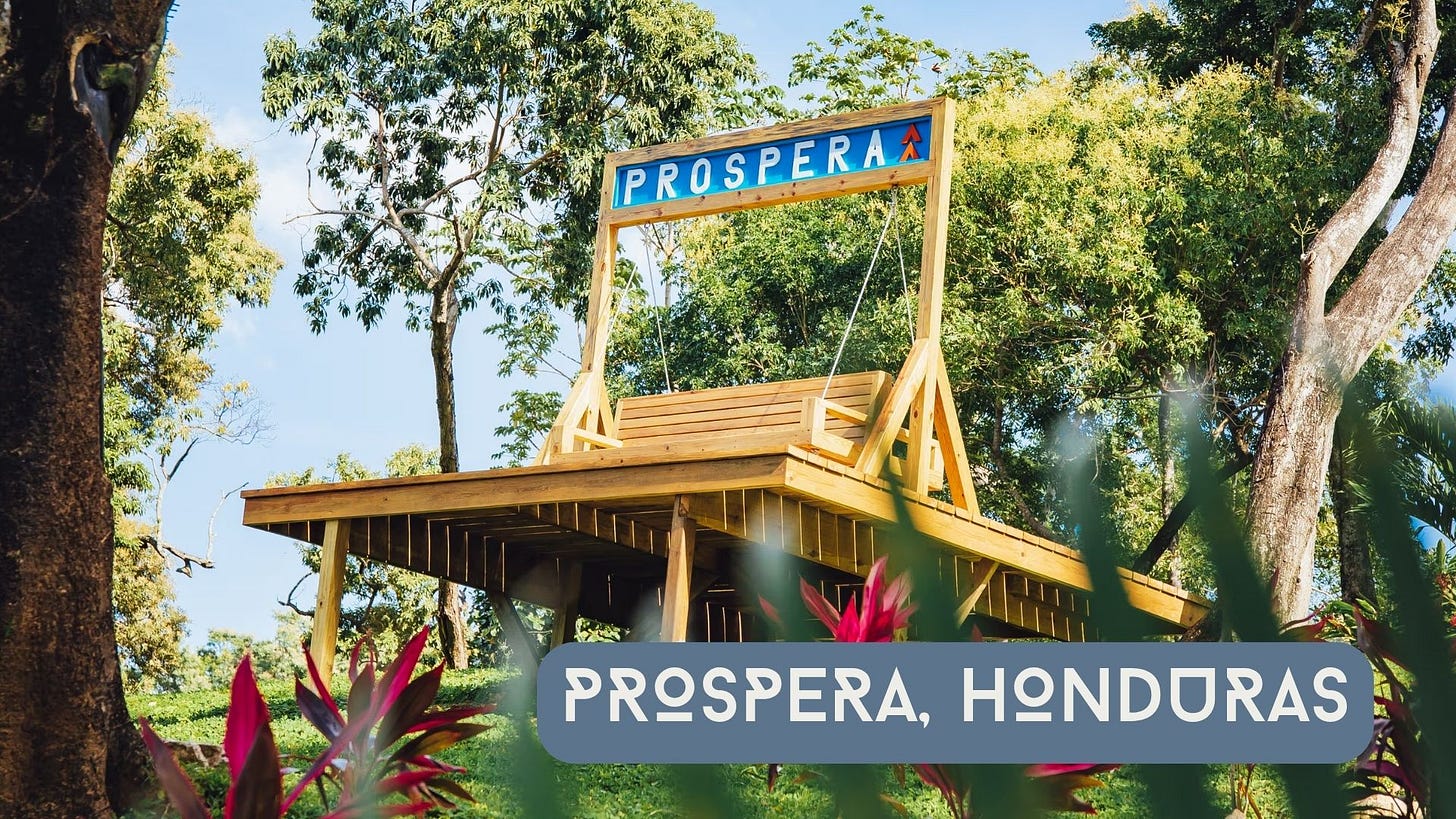
1. Próspera (Honduras)

Próspera began as a bold libertarian experiment on the tropical island of Roatán, off the northern coast of Honduras. It’s the brainchild of Erick Brimen, a Venezuelan-born wealth fund manager who imagined a city run not by politicians, but by market forces and blockchain logic. He’s aiming to create a low-tax, deregulated tech haven where businesses can make their own laws, or choose to implement existing national laws from a menu of 36 countries. Residents pay low taxes (payable in Bitcoin), and biotech startups push the limits of radical life extension with experimental, as yet unproven treatments disallowed in other countries.

With venture capital backing from Coinbase and Sam Altman–linked projects, plus support from figures like Peter Thiel, Próspera has quickly become a magnet for crypto evangelists, longevity obsessives, and deregulation devotees. It hosts conferences with themes like: “Make death optional.” It’s creating a walled city with private arbitration courts, judges who adjudicate online from Arizona (no idea why Arizona — our research was not explicit), and QR-code entry checkpoints.

But like all utopias, this charter city dream has clashed with reality. One critic called it a “libertarian fantasy… that’s not going to turn out well.” The Honduran government that initially supported the project and allowed for the zoning laws making it possible has since collapsed in scandal — with the former president serving time in US prison for conspiring to import and distribute over 400 tons of cocaine. That’s a lot of blow.

Locals in the nearby village of Crawfish Rock have not taken kindly to the idea of the gated city and have accused Próspera of land grabs, environmental damage, and trying to push them out. When the current democratic socialist President, Xiomara Castro, declared the former administration’s zoning laws unconstitutional, Próspera fought back in international court, demanding nearly $11 billion USD in damages — about a third of the country’s GDP — an amount that would bankrupt the country if they lose the case.

Brimen is doubling down, lobbying American politicians to argue in his favor and launching a spin-off project aimed at Africa.

This all plays out as an ironic twist of history: a 21st-century version of the banana republic, complete with foreign investors, private courts, and corporate control over land, law, and labor. The term ‘banana republic’ was coined by author O. Henry to describe Honduras — a place where US fruit companies ran the economy. Now, crypto-capitalists and Silicon Valley VCs are picking up where the plantations left off, except this time, they’re promising immortality instead of bananas.

2. NEOM (Saudi Arabia)

NEOM was supposed to be Saudi Arabia’s leap into the future: a $500 billion high-tech oasis in the desert that would make even Silicon Valley blush. Conceived in 2017 by Crown Prince Mohammed bin Salman as the crown jewel of his Vision 2030 plan, NEOM promised flying taxis, robot dinosaurs, artificial moons, a desert ski resort with fake snow, and a 170-kilometer mirrored city called The Line.

On October 6th President Trump’s words shook the world.

So pay chose attention because this video will change your life forever for the good!

This mirrored city was meant to stretch 170 kilometers across the desert with no cars, no roads, and no emissions — just smart infrastructure, biometric surveillance, and those previously mentioned flying taxis.

But like many utopias, the fantasy is already buckling under the weight of reality. The goal was for The Line to eventually be home to 9 million people, with 1.5 million residents by 2030. Middle East Eye reports that Saudi officials now predict fewer than 300,000 in that time frame. Only 2.4 kilometers of The Line may actually be completed by 2030. Oil revenues — the main funding source — have declined sharply, and insiders say the kingdom is facing an “environment of limited resources.” Budget reviews are underway, and other NEOM projects (like the year-round ski resort) have been shelved, delayed, or drastically scaled back.

Behind the glossy renderings lies a construction project with a dystopian work culture. NEOM’s former CEO, Nadhmi al-Nasr, developed a reputation for abusive management. “I drive everybody like a slave,” he said, celebrating “[w]hen they drop down dead… That’s how I do my projects.” In one case, he told an employee to “walk into the desert and die” so he could urinate on their grave. As a result, there has been a mass exodus of foreign executives, many of whom forfeited six-figure contracts just to escape the toxic environment.

Meanwhile, members of the Howeitat tribe, native to the land NEOM occupies, have resisted the development. Many have been forcibly removed, at least one activist was killed, and others have been imprisoned for resisting eviction. Human rights groups have condemned the project, while NEOM’s own consultants warned that the mega-structure could actually change the weather and decimate bird populations due to its massive mirrored walls.

None of this matters; Saudi officials press on. Promotional videos still promise a gleaming future where “Neomians” live in harmony with nature, technology, and robot dinosaurs. But those on the ground tell a different story — of constant surveillance, sexual harassment allegations ignored by leadership, and Orwellian control over employee life. Promises of a liberalized social zone — with alcohol, gender mixing, freedom — have quietly been walked back by a government known for its public stonings and other extreme punishment for ‘immorality.’

NEOM may, in fact, never turn out to be the future of urban life. But it may just be the world’s most expensive monument to authoritarian delusion: a dystopian nightmare of a city built on sand, surveillance, and slogans.

3. Telosa (Somewhere, USA)

Telosa is what happens when a billionaire tries to build a utopian city without using the word ‘utopia.’ Marc Lore, former Walmart executive and founder of Jet.com and Diapers.com, envisions a new city rising from scratch somewhere in the American desert (or possibly Appalachia), designed to be sustainable, walkable, tech-forward, and just equitable enough to keep you from asking too many questions.

According to Telosa’s website, this categorically, definitely, 100 percent isn’t a utopia.

Is the goal to create a utopia?

No, we are absolutely not attempting to create a utopia. Utopian projects are focused on creating a perfect, idealistic state — we are not. We are firmly grounded in reality and what is possible.

We are focused on the best, most sustainable solutions for infrastructure, urban design, economic vibrancy and city services, but we fully recognize that no solution is perfect and all human systems have flaws. Therefore, we are committed to new ideas, finding the best way to solve difficult problems and constant improvement.

And yet the renderings and promo videos suggest otherwise: gleaming towers, shaded plazas, handicap-accessible courtyards, and monorails slicing silently through eco-optimized zones. If it looks like utopia, smells like utopia, and plans to engineer human behavior like utopia — well, you do the math.

The project is called “Telosa,” from the Greek word telos — meaning “highest purpose.” Hey — stop calling it utopia!

The big idea is for 50,000 people to move to this yet-to-be-determined place by 2030 and have the population eventually grow to 5 million. Everyone lives within a short walk (15 minutes maybe?) of everything they need — a school, a park, a job (lolz!), and probably an AI wellness coach. Cars, of course, are banned. There will be solar-powered towers and vertical farms and an economy based on “equitism,” a remix of a 19th-century idea where the city itself owns the land and uses rising property values to fund social services.

But for all its lofty ideas, Telosa has yet to put a single shovel in the ground. There’s no final site, no government approval, and no clear funding beyond Lore’s initial push. It’s still just a shimmering concept, a mirage sketched by a star architect (Bjarke Ingels) and floated in interviews, TED talks, and design expos.

Critics argue that if Lore really wanted to help people, he could invest in solving infrastructure problems in existing cities. Others point out that “15-minute cities” — the model Telosa clearly mirrors — have become a global flashpoint, praised by urban planners but derided by skeptics as a way to centralize control, limit movement, and monitor citizens.

So far, Telosa’s biggest achievement is that it’s really good at marketing a city that doesn’t exist. If it ever does gets built, we may finally get to ask: does a billionaire-designed city really offer freedom — or just the illusion of choice in a world where the architecture has already made the decisions for you?

4. Seasteading & Arkpad (Southeast Asia)

If you’ve ever dreamed of escaping taxes, regulations, and society itself, there’s a billionaire-funded plan for that: Seasteading — the floating libertarian fantasy that just won’t sink, no matter how many times it fails.

First floated (literally and ideologically) by the Seasteading Institute in 2008, the project was originally funded by… wait for it… Peter Thiel. He envisioned self-governing cities bobbing peacefully in international waters until backing away from the idea and stating they were “not quite feasible from an engineering perspective.”

The concept was a nation without a nation, where entrepreneurs could escape pesky things like labor laws, zoning, and democracy. In short: Silicon Valley meets Waterworld, minus the humility.

An initial prototype near Thailand ended with Thai authorities raiding the floating platform and accusing the residents of endangering national sovereignty, an offense punishable by life imprisonment or death. The couple that lived on the house boat went into hiding and the Thai navy eventually hauled away what was essentially a raft with Wi-Fi.

This photo provided by Royal Thai Navy, shows a floating home lived in by an American man and his Thai partner in the Andaman Sea, off Phuket island, Thailand, April 13, 2019.

The broader Seasteading movement has since splintered, evolved, and — most recently — mutated into a newer project with fresher branding: Arkpad. “By building a community in the ocean, you’re not just creating a home; you’re crafting a legacy of innovation, freedom, and sustainability,” reads the marketing copy.

Arkpad bills itself as a “sovereign lifestyle project” and a “network state” — crypto-native language for the same old dream: private governance, no taxes, total control. Based in the Philippines, Arkpad is aiming to build on ocean-based platforms and create a floating community, complete with decentralized ID systems, underwater real estate, and NFTs for residency. Because, of course.

Their YouTube channel mixes crypto sermons with dreamy renderings of sleek structures rising from the sea — modern-day Noah’s Arks, minus the animals or flood, but heavy on Bitcoin and barnacles. Watch the videos carefully and you’ll see the architects’ sleek computer-generated renderings blur into the reality of what an Arkpad really is: a concrete block floating in the middle of absolutely nowhere. No word on whether they supply residents with free Dramamine.

Check out that roof deck — no Jimmy Buffett vibes here.

Just like Seasteading before it, Arkpad suffers from a chronic case of reality avoidance. Engineering constraints, rising ocean temperatures, maritime law, international sovereignty, and basic logistical challenges all still exist. What’s more, these projects have always been less about freedom for all and more about escape for the few. Not everyone is invited to these floating utopias. They’re luxury lifeboats for a digital elite preparing to sail away from the consequences of the world they helped wreck.

Until further notice, Seasteading and Arkpad remain what they’ve always been: libertarian lighthouses in the fog — glowing ideals with no mooring in the real world.

Final thought: utopias always fail

Whether real or imagined, all these utopian concepts promise clean slates and high-tech harmony in their own way, plugged into the seductive guarantee of a new way to live. Blockchain ruled and perfect in efficiency, there remains only one slight problem: Reality.

History shows that when elites indulge in the fantasy of utopias, reality always gets in the way. Wealthy eccentricity is tolerable for a small group of like-minded disciples, but humans are not robots. Therefore, it’s unlikely that a utopia cooked up by some micro-dosing, immortality-seeking tech bro could ever be scaled up except through heavy reliance on surveillance, coercion, and control — where things eventually devolve into socially engineered, privacy-erasing digital prisons, wrapped in glossy marketing brochures and eco-communal delusion.

There’s also the problem of governments — they’re not into the whole competition thing. But hey, that’s not going to stop these billionaires from trying. So in part two of this series, we’ll look at some of the other ways billionaires are planning to control the future of urban living and how it might affect you.

The most shocking videos in the world! (Full video below)

I also invite you to take a look at this site- www.whatfinger.com


The Weekend the Money Stops

The notification arrives at 4:47 on a Friday afternoon, from an app you rarely open. It says that one of the big banks, a name you have used...