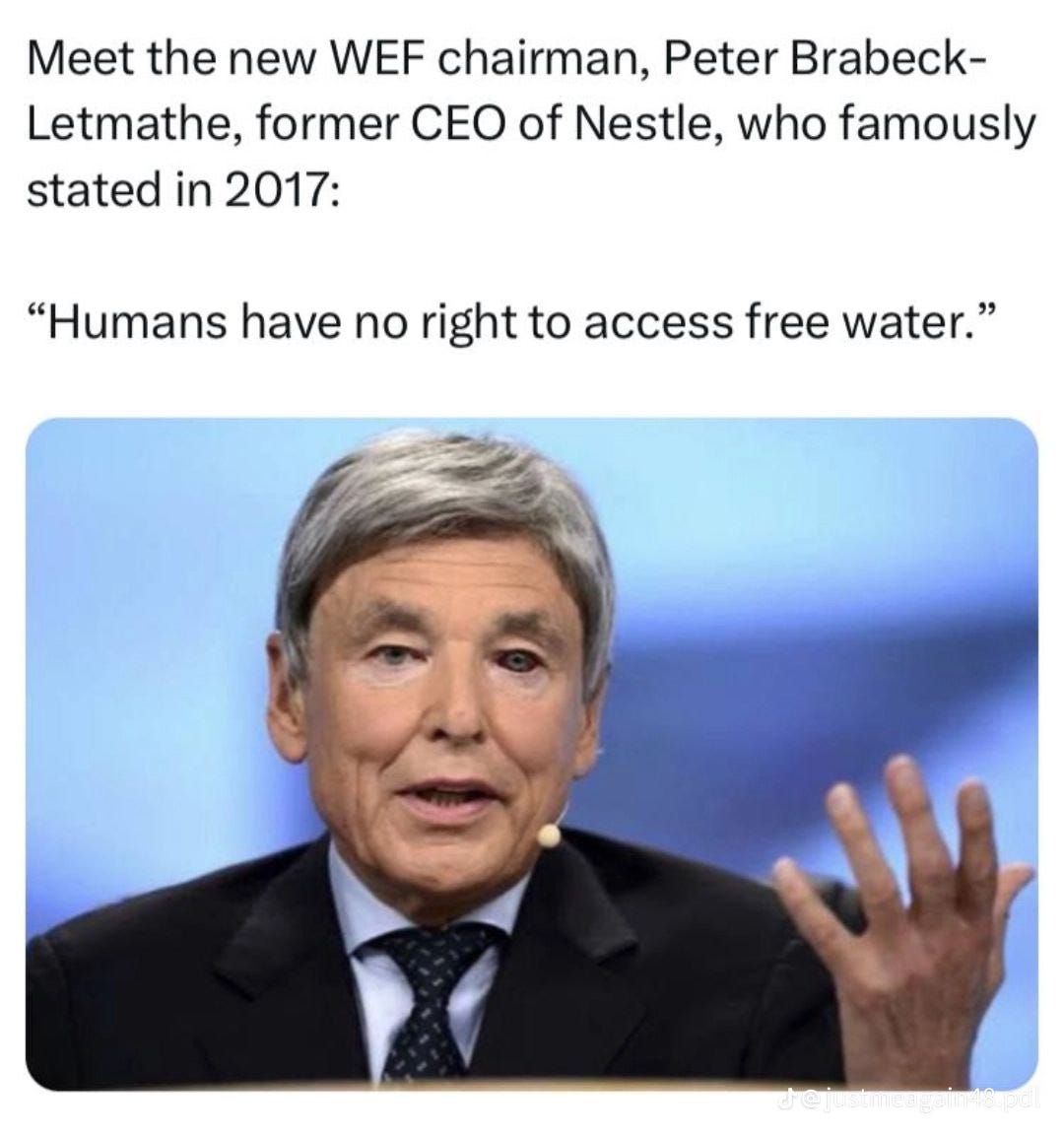
Recently, a phrase has resonated in power circles and on social media that has put many on alert: “Humans have no right to access free water.” This enigmatic comment comes from the newly appointed president of the International Economic Forum, Peter Brabeck, a figure who, from his position of influence, has made statements that seem to challenge basic notions of human rights and individual freedom.
Peter Brabeck-Letmathe’s professional career is intrinsically linked to the multinational giant Nestlé, where he began working as a simple salesman in 1968 in Austria, where he would later become a new product specialist. Between 1970 and 1980, he was in Chile, first appointed as national sales manager and later as marketing director. In 1981, he was appointed general manager of Nestlé in Ecuador, and in 1983, he was elected president and general manager of Nestlé in Venezuela.
Brabeck’s statement can be interpreted as a simple provocation, but in the context of current reality, it takes on a much deeper meaning. Why would a leader of an organization that supposedly seeks global well-being make a statement that denies one of humanity’s most fundamental rights? Is this perhaps an attempt to justify total control over natural resources and, consequently, over the world’s population?
Analyzing the speech, several hypotheses arise: some global watchdog experts suggest that statements like this could be a coded message directed at certain powerful sectors, signaling the possible establishment of a system in which basic human rights are subordinated to the interests of a few. The management of water, an increasingly scarce resource, has been a key item on the agendas of international organizations for decades, and it would not be surprising if in certain circles it is seen as a tool to consolidate absolute dominance.
Such statements can also be interpreted as a strategy to discredit the idea that natural resources are a universal right, thus facilitating privatization and corporate control over these essential resources. The narrative that “humans don’t have the right to water” may be one more step toward a system in which survival becomes a privilege of the few, rather than an inalienable right.
What truly catches the attention and raises concern is a deeper question: Why does the president himself speak of humans as if he were not one? Think about this.
In the fall of 2010, a Chinese fishing boat was trawling off the coast of the Senkaku Islands, a territory given to Japan after World War 2 but never officially ceded by China. Upon being spotted by the Japanese Coast Guard, the trawler attempted to flee, but after being chased, it eventually rammed itself against the pursuing ship in a final act of desperation.
Two weeks later, in response to the fishermen’s arrest, China abruptly stopped all shipments of Rare Earth Metals to Japan, throwing their markets into turmoil. At the time, Japan sourced upwards of 90% of its rare earths from China (as did the rest of the world), as over the past few decades, China had gained near complete market dominance.
This ban, while scary at the time, ended up being relatively inconsequential to Japan, primarily because it was largely undercut by illiegal shipments out of China (a practice they have now harshly cracked down on), and due to a WTO ruling (which China publicly disagreed with, despite complying with it) which caused the ban to only last a few months. It did, however, wake Japan up to the danger of their reliance on China, causing them to diversify their mineral sources through massive investment in Australia, from which they now source close to 30% of their rare earths.
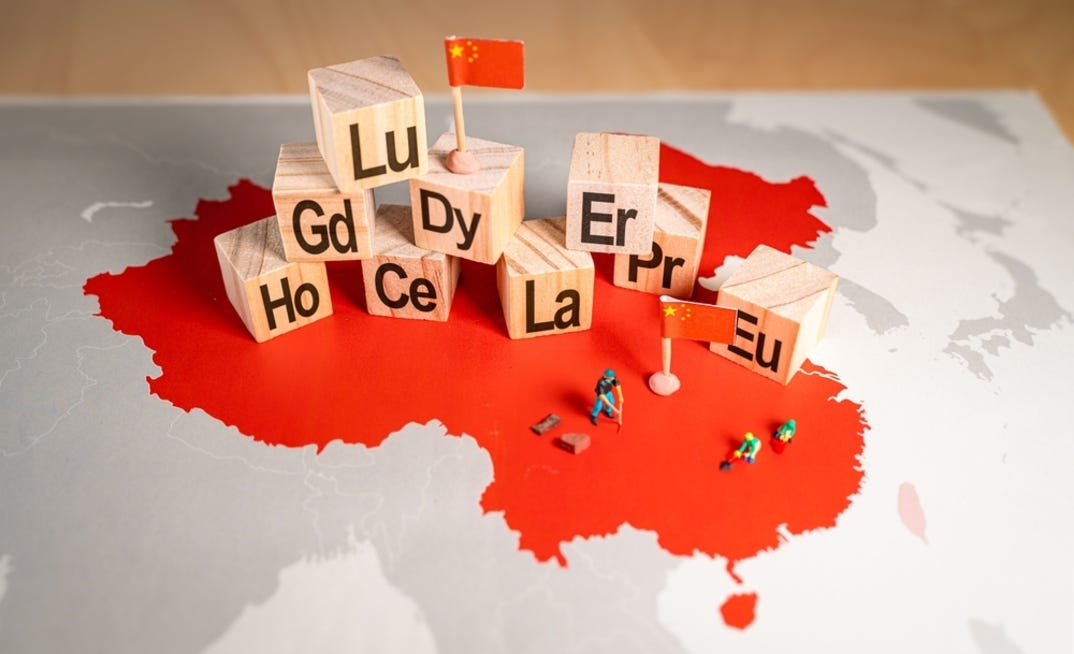
Despite the relatively small scope of China’s embargo, its potential danger at the time cannot be overstated. This group of 17 elements is the backbone of nearly all modern technology, from satellites to renewable energy to most modern weapons systems. Once refined, they are used to build magnets (necessary for wind farms and electric vehicles), catalysts (used for a wide variety of industries, but particularly useful to refine petroleum), and high-powered lasers used by the military.
Now, despite their name, these elements are not all that rare and are actually pretty abundant across the globe. They are, however, incredibly hard to extract in economically viable quantities, and even harder to refine (even this is not where the word rare comes from though, the name actually came about because, when the elements were discovered, they had never been seen before, which is a bizarre way to name new things, but I digress). Given the high upfront costs needed, it is now incredibly difficult to compete with China, which has a very well-established industry, near complete market dominance, and has been known to undercut other companies by cutting their own prices (making it impossible for new companies to compete).
Given the immense importance of these supply chains, how did we get here?
In 1980, following the short-lived rule of Mao’s successor Hua Guofeng, Deng Xiaoping emerged as the de facto leader in China, filling both the party and state apparatuses with loyalists, and maintaining his position as the vice chairman of the Chinese Communist Party. Amongst other divergences from Mao, his economy was opened to international markets, and allowed to be driven more by market forces, with more emphasis on centralized control rather than central planning. This era of Chinese history is thus marked with great economic expansion, and the birth of China as we see it today – as a manufacturing superpower.
Among these expansions was the birth of China’s rare earths industry. Blessed with somewhere around 30- 40% of the world’s known rare earth deposits (the most of any single country), China was uniquely poised to take over this market, but was far behind in the industrialization needed to take advantage of these reserves. In the decades following Deng’s ascension, three key factors allowed China to emerge as the sole superpower of rare earths.
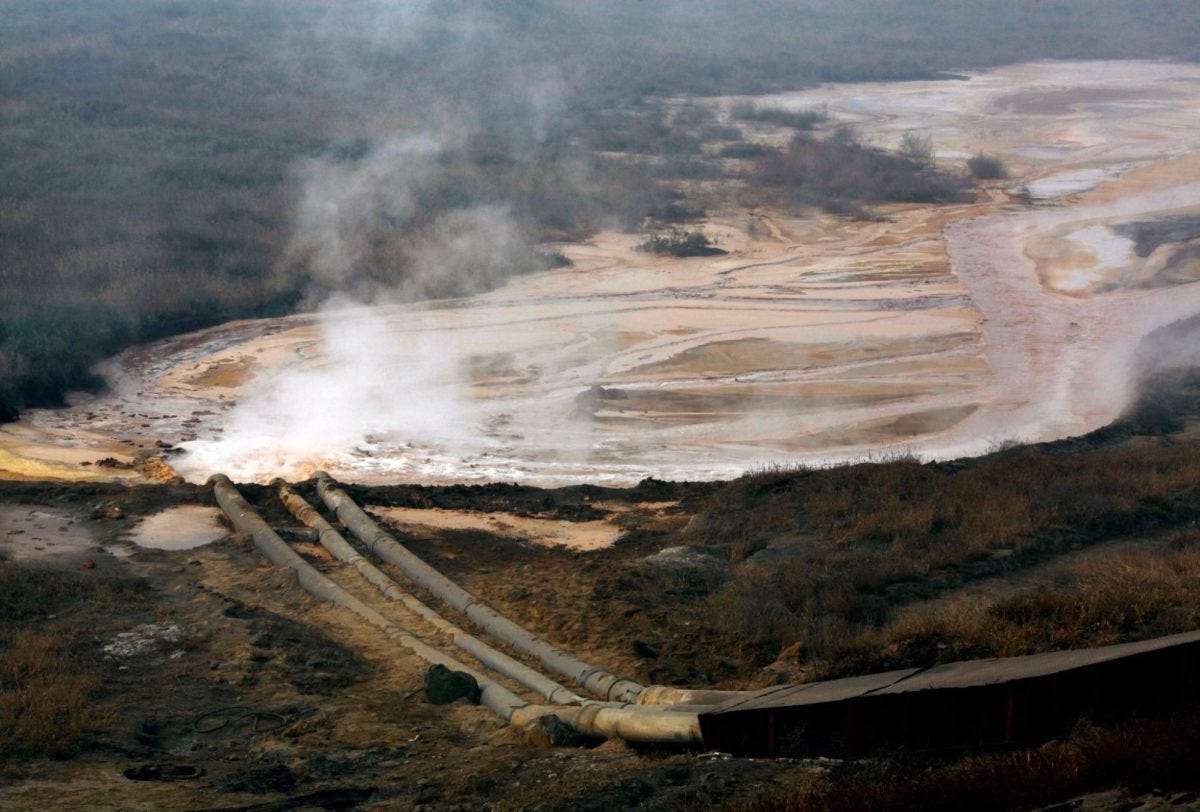
The first is relatively simple, and the same reason why China was able to take over so much of global manufacturing within this same time period. Due to their low labor costs and relative lack of environmental standards, the costs of doing business in China were immediately much lower than anywhere else around the globe. That second part is key for rare earths – their extraction is absolutely horrible for the environment, which is a big reason why globally it takes on average 16 years to open a new mine. China’s lax regulation of environmental standards allows companies to dump waste products into the Yellow River, generate upwards of 10 million tons of wastewater a year (which is subsequently discharged without being treated, contaminating agricultural and potable water), and dump radioactive material. From 1990 to 1997, the cancer mortality rate in Bayan Obo (a rare earths mining district in Inner Mongolia) went up 50%, and the three leading causes of death were cancer, poisoning, and child mortality. Despite the human costs, however, the disregard for environmental consequences allowed China to skyrocket its production and attract investors from all over the world.
Baogang Tailings Dam in Inner Mongolia.
China then put its central planning to work, recognizing that rare earths were of vital importance to the global economy, and heavily subsidized its domestic industry, pouring money into it, and giving a 17% tax rebate for exporters. This heavy subsidization was accompanied by pouring money into R&D, pushing China forward in terms of extraction and refining technology, which was coupled with weak IPR enforcement, allowing the new technologies to proliferate amongst Chinese companies. These practices gave China a first mover advantage in rare earths processing and refining, eventually giving them the complete market dominance we see today.
The last part of China’s rare earths policy laid the foundation for the retaliatory export controls we are now seeing. Once China gained control over the market, it became very protectionist, distorting the global supply of minerals and limiting international cooperation. Whereas before, they had incentivized international cooperation and investment (particularly with Japan and the US) to facilitate the inward flow of technology and research, they now began to restrict it to limit the outward flow of their technology and research, having gained primacy.
Simultaneously, in the 90s and 2000s, China began to set lower and lower export quotas for rare earths, going from 65,000 tons in 2005 and just 30,000 by 2010. See, by this point, China was mining close to 100% of all rare earths globally, no country could compete, so by lowering the global supply, while keeping their domestic supply high, they made critical metals much cheaper for their own companies. This move allowed China to effectively vertically integrate the entire supply chain. It was now much cheaper to just buy the refined and finished products from China as well, where the cost was substantially lower. Though they would later abolish these export quotas (after the WTO ruled they violated free trade), this, however, only helped China, as it flooded the market, undercutting most other distributors of rare earths. Unsurprisingly, within this time, the two American companies capable of mining and refining rare earths, Magnequench and Molycorp, went out of business (the former was bankrupted by the supply squeeze and bought by Chinese firms, and the latter was undercut by the supply increase and crushed by debt).
In the following years, other countries have been able to regain a bit of a foothold in the actual mining process, and as of 2023, China mined around 70% of the world’s rare earths.
The damage, however, had already been done. China now controls somewhere between 85-90% of all heavy magnet production (by far the most used and profitable application of rare earths), and produces close to 100% of all heavy rare earths. Despite the fact that mines are opening up around the world, they all still send their rare earths to China to be refined and turned into usable products.
Now, this next section was supposed to be a prediction, saying that the past few decades of increasing market manipulation and retaliatory export controls meant our current tariff debacle would have the hidden unintended consequence of more expansive export controls. Unfortunately, it seems Xi Jinping (in an obvious attempt to undermine me specifically) beat me to the punch by putting bans in place this week, just a few days before I was going to publish this. So instead, let’s look at the implications of the ban China has implemented.
On April 4th, in response to further tariff hikes, China placed licensing restrictions on six medium and heavy rare earths, as well as on heavy magnets. All of the elements and magnets they have placed licensing restrictions on have a wide variety of both civilian and military applications (which likely makes this restriction WTO compliant), and are produced and refined in negligible quantities outside of China. While this is not exactly a ban, it just requires companies to now get licenses to export, it is likely to function as a ban similar to those that have come before it.
Before this last week, there had been two bans put on specific rare earths. The first came in 2023, when China banned exports of graphite (not a rare earth, but still an element critical for batteries and with a wide range of both civilian and military technology) to Sweden. The ban came as Chinese investment in battery factories across Europe (Poland and Hungary specifically). Now, one of the biggest companies in Europe’s nascent battery industry, Northvolt, just so happens to be based in Sweden. This ban, similar to the one we’re seeing now, was not an official ban, but a tweak to the export licensing system. The second ban was on the US in 2023. Following Biden’s semiconductor ban, disallowing our biggest chip companies like Nvidia to sell their best semiconductors to China, they responded by cutting off global Gallium and Germanium supplies (also not rare earths), two elements key in the manufacturing of said semiconductors.
Lastly, during Trump’s first trade war in 2019, Xi Jinping visited one of China’s cutting-edge heavy metal magnet factories, in a move that was widely perceived to be a threat to cut off their global supply. While this was not followed through on, likely due to the tentative agreement reached in 2020, this time the threat was followed through on.
These instances, as well as the policy surrounding all of China’s history with rare earth mining, refining, and production, show that they know how to protect their own industries and undercut the rest of the world. At some point, it no longer makes sense for China to continue to match our tariff level, because our trade deficit means they will always hurt more from that than we will, but what they can do is cut off our ability to actually build the products we need.
To their credit, Trump and his admin appear to understand the vital interest we have in securing this supply chain in a way I don’t think other presidents have before.
To their discredit, however, the way they’re going about it is fucking insane.
Even ignoring the fact that his trade policy has begun to cut off supplies in the short run, his incorporation of them into the center of his foreign policy is terrifying.
Specifically, his threats of annexation of Canada, taking over Greenland, and conditions to Ukraine aid all seem to have the throughline of shoring up our supply chains. When it comes to Ukraine, the cards are already on the table. The deal for Ukraine aid (which now may fall through anyway) was contingent upon the US getting to extract rare earths from Ukraine. Now, there is no credible evidence (save for some Soviet reports from the 60s) that there are rare earths in Ukraine, and even less evidence that whatever deposits they have could be worth anything (remember, the elements are everywhere, it’s about finding deposits big enough to justify the exorbitant costs). Ignoring that teensy detail, however, replacing one land-grabbing power in Ukraine with another is repugnant in my eyes. I can understand the arguments for it, that we ought to “get something out of” our aid to Ukraine, and I strongly disagree with this point of view. However, I am not going to go into the whole Ukraine debate here, and think the logistical challenges are reason enough that this plan is bad.
The even more clear-cut examples of bad policy towards the end of securing our supply chain are Canada and Greenland. For Greenland, the Trump admin has very explicitly said that they want to annex our ally for its mineral deposits. While it’s true that Greenland seems to have viable deposits, large questions remain surrounding the feasibility and cost. Annexing Canada, meanwhile, exists in this nebulous gray zone of being a joke when the idea is criticized, and being a serious policy proposal. While Trump and his admin are yet to comment on it, Trudeau has openly said that he believes Trump wants Canada for its vast mineral deposits.
Now, I don’t think the US will take over these countries any time soon, but the rhetoric surrounding American expansion is incredibly dangerous. Much of this administration seems to be reliant upon this pernicious attempt to shift the Overton window on American values, pushing us further and further towards an incredibly dangerous world. We may not invade our neighbor to the north in the next four years, but what happens when the formative political years of future politicians are filled with the idea that expansion and imperialism are key to our national security?
Outside of Trump’s foreign policy delusions, however, there is some potential good news for our supply chains and security, as we do have some prospects for companies that may be able to combat Chinese market dominance. The first is Lynas, an Australia-based rare earth mining company that produces medium and heavy metals, which was the result of Japanese investment following the embargo in 2010. The second, and more promising in my mind, is MP Materials, an American company that operates the only functional rare earth mine in the US. MP, however, is not solely a mining company, and in 2022 received grants to build up factories to process and refine rare earths, and to produce NdFeB Magnets. It is now poised to produce around 1000 tons of these magnets this year, with plans to ramp up production down the line.
A couple months ago, I invested a little in both these companies, and they have weathered the tariff storm decently well.
While the market looks something like this:
My money has looked a bit more like this:
This is not to brag or show off, but to offer what is likely going to be some of the only investing advice I ever give (in addition to telling you that you should consider buying low and selling high). I believe these companies will likely increase greatly in value over the next few months and the next few years, as the West has begun to wake up to the fact that we need to decouple this industry from China. Following the export bans on the 4th, both of them jumped about 25%, and have continued to grow. They aren’t without their drawbacks, however. Lynas is likely never going to be worth all that much, as it is just a mining company, which means it’s going to be relatively stable. MP, on the other hand, is subject to the ever-changing whim of Trump. Following its initial 25% increase on day one, it has sunk a bit and is likely to sink more on Monday, now that it has stopped selling to China due to their retaliatory 125% tariff. Despite these drawbacks, I do believe that both of these have a high potential in my mind of seeing tremendous gains over the next few months and years.
The subject of the dollar’s strength and its ability to remain the world’s reserve currency has been a subject of much debate. When thinking about the dollar it is important to note two things, first, it is often described as the cleanest dirty shirt in the closet. This simply means all other fiat currencies are worse or have more problems. Second is that there are more dollars outside the US than inside it, these are referred to as eurodollars.
The term “eurodollar” refers to unsecured U.S. dollar-denominated deposits at foreign banks or overseas branches of American banks. These dollars that are held outside the United States, are not subject to regulation by the Federal Reserve Board or regulations relating to reserve requirements.
In short, despite the name, eurodollars have nothing to do with the European Union or the euro currency. The name, a post-World War II moniker simply refers to the massive use of dollars in the global financial system outside of the United States. This means much of the debt in the world is based and must be repaid in dollars. The eurodollar plays strongly into what is happening across the world.
This is why global strategist Michael Every of Rabobank takes the stand the dollar is going “nowhere” or to clarify, it is solidly entrenched for now. He claims there may be ten times more dollars floating around outside of America than inside and much of the global offshore debt is owed in dollars.
The kicker here is that a trade war and tariffs have the potential to result in fewer exports to America. This translates into less dollars for those in other countries to pay back this debt. Logically this means a stronger dollar outside of America as creditors are forced to pay more for dollars needed to pay back existing obligations. It also sets up a potential liquidity squeeze for those finding themselves owing dollar-denominated loans. The eurodollar market is key to Brent Johnson’s Milkshake Theory of a stronger dollar in the future.
He makes a strong case that the current forces flowing around us are a game changer. He also addresses the future of the bond market and U.S. dollar dominance. This has major implications for investors navigating the macrogeopolitical and economic news coming out every day.
As a Global Strategist, Every puts forth an expansive and thought-provoking conversation on the tectonic shifts shaping our world. This includes the collapse of the architecture based on a US-protected world. He makes it clear that the post-WWII order is changing, due to what he calls the rise of economic statecraft.
This is all happening at a time when we are witnessing the emergence of a multi-polar world and Europe is turning toward a Kenseane expansion of economic growth based on building a strong military complex. This is rooted in the questionable notion that Russia is about to attack and Europe must defend itself. Whether such a static can halt the decline of the Eurozone is questionable.
This approach by warmongers is also not conducive or reassuring to those wishing to achieve peace in Ukraine. The recent decline in the dollar may be overdone and the result of a combination of factors. Consider the possibility that the dollar’s recent fall is the result of a blatant anti-Trump attack by the Eurozone and UK to destroy America’s dominant global position in an effort to reestablish them as world powers. This includes dumping US Treasurys and pulling money back across the pond.
Uncertainty has been the word of the month, clearly, thereis good reason to be cautious and move forward with a “buyer beware” attitude before listening or taking to heart any of theopinions being floated about by all the experts. In all honesty, there is little consensus on anything. A big part of Every’s reasoning is based on the idea reality is rapidly changing and not everyone has updated their stand.
According to: knowledge.csc.gov.sg- Many economists have described the current economic and financial crisis as the most severe economic recession since World War Two. The crisis has indeed had far-ranging consequences: oncemighty banks and financial institutions have evaporated; major industries are experiencing significant consolidation; thousands of factories all over the world have shut down, and millions of workers have lost their jobs. Some economists have even speculated that the world was poised for a second Great Depression.
It is still too early to determine if the global economy has indeed seen the worst of the downturn as there are simply too many uncertainties that could destabilise any sort of recovery. However, it has become increasingly clear that the global economy will not revert to its pre-crisis status quo.
Focusing on Trump’s tariffs risks missing the bigger picture. The consequences of upending the global economic order on this scale will not be limited to trade.
A few thoughts on Liberation Day:
1. Trump just blew up what was left of the global rules-based trading system. Since the 1940s and the launch of the General Agreement on Tariffs and Trade (GATT), it has been a cardinal principle of the global rules-based trading system that countries should treat all members of the World Trade Organisation equally. America has now shattered this principle of non-discrimination by applying very different tariffs to trading partners, ranging from a baseline 10 percent up to 54 percent on imports from China. The rest of the world may, and indeed should, try to cling on to what remains of the system as a global public good, but the reality is that the trade distortions and diversions of what Trump has just done may be so profound that retaliatory and discriminatory tariffs start cropping up everywhere, leading to chaos.
2. As a result of Trump’s tariffs, America’s average tariff is now estimated to have soared to between 25 and 30 percent, far above the 20 percent level that it reached in the 1930s following the introduction of the infamous Smoot-Hawley tariffs. What’s more, this is a far larger and more rapid hike than the Smoot-Hawley tariffs. They were introduced in two phases and only applied to 20,000 items. In contrast, Trump’s tariffs apply to pretty much everything other than a few metals and other critical resources. Yet the Smoot-Hawley tariffs and the retaliation that they invited were sufficiently damaging to lead to a 60 percent reduction in global trade, deepen the Great Depression and fuel what turned into economic and political disaster in Europe.
3. The idea put about by some investment banks that this announcement will draw a line under the uncertainty that has hung over the global economy since Inauguration Day is surely for the birds. For a start, almost of all of Wall Street and the City has been spectacularly wrong-footed by the sheer scale of these tariff hikes. They have consistently misjudged the Trump economic agenda at every stage since his election victory in November, not least in assuming that his tariff threats were all about leverage rather than a profound ideological shift in American economic strategy. The result is that global investors overwhelmingly began this year long US equities and the dollar and short Europe and China. Wealth of Nations readers knew better, and now the financial markets will need to revisit all their assumptions.
4. More importantly, the Trump tariff plan is so half-baked that no one can possibly know what the future may hold. Are these tariffs a floor or a ceiling? The Executive Order announcing the tariffs claims, as if it were some kind of concession, that the new duties have only been set at half the level of the tariffs that the US government calculates other countries apply to the US. But it says that these tariffs could rise if other countries decide to retaliate, or could be lowered if they take action to allow “reciprocal trade”. Yet Trump has calculated these “tariffs” applied by applying a formula which, in effect, divides America’s trade deficit with a country by its total imports from that country. This is such a ridiculous back-of-an-envelope methodology that it hard to know what they are supposed to do to negotiate their rates down.
5. To see the problem, consider Vietnam, one of the countries hit hardest by Trump’s plan. As GaveKal explains: America runs a US$123bn deficit with Vietnam from which it imports US$137bn. So according to Trump, it is deemed to have trade barriers equating to a 90% import tariff. The US formula applies a reciprocal tariff of half that (45%), which should be enough to reduce the bilateral deficit by half. But in reality, Vietnam does not have trade barriers equal to a 90% tariff, so it cannot remove them. It has a strong comparative advantage in manufacturing and a position in global supply chains which means that it can export a lot of goods to the US (although most of the value of those goods is created elsewhere, chiefly China). And it has relatively low income, so it is not yet a good market for most of the things the US has to sell. The result is that “a small, low-income country like Vietnam does not have a lot of options other than to permit a massive depreciation of its currency or suffer a hit to economic growth”.
6. Just how damaging Liberation Day will prove to global growth is impossible to say, even if the finest minds on Wall Street and the City are hard at work trying to come up with an answer. That’s because everything hinges on how the rest of the world responds, particularly the European Union and China. At least they, unlike Vietnam, have options. They will have to decide whether to try to negotiate with Trump, raising the risk that he keeps banking concessions while throwing in fresh demands, not limited to trade, or to retaliate and risk escalation. But they do also have the option to reflate their domestic economies via fiscal and monetary stimulus and structural reforms. That would help contain some of the economic damage. Crucially, China also has the option of allowing further devaluation of the Yuan, albeit at the price of exporting the shock to its own economy the rest of the world.
7. The idea that in this dark global economic environment, Britain is some kind of winner from Trump’s trade war is bizarre. The fact that Britain is only being tariffed at 10 percent, half the level of the EU, is being talked up by Brexiteers as some kind of Brexit bonus. Leave aside the fact that Britain’s supposedly closest ally has just slapped a punitive tariff on the country even though it runs a trade surplus with America, the idea that avoiding a 10 percent additional duty on Britain’s relatively modest exports to America somehow validates an act of national self-harm that cost 15 percent of its trade and four percent of its GDP is absurd. Nonetheless, the danger is that this narrative will further complicate efforts to reset the trading relationship with the EU. Meanwhile, given its precarious fiscal position and broken economic model (in part due to Brexit), Britain is particularly vulnerable to a sharp downturn in global growth – and unlike the EU, the UK has few domestic levers to pull. Morgan Stanley reckons the new tariff regime could knock up to 0.6 percentage points off UK growth.
8. In the near-term, it is hard to see how Trump’s tariff plans can be anything other than negative for US stocks and the dollar. The UBS economics team, for example, believes that US real GDP this year could be down by 1.5-2 percentage points and inflation could rise to close to 5% if these tariffs are not reversed soon. The investment bank suggests that given such damage, the tariffs will have to be reversed. I doubt that very much. Trump has made clear that he sees tariffs as a key part of a complete overhaul of the US tax system. He needs the revenues to pay for income tax cuts. Even if some higher duties are eventually negotiated down, the 10 percent baseline is surely here to stay. Lower growth and higher inflation means that US equity valuations will “inevitably contract”, say Ian Harnett and David Bowers at Absolute Strategy Research since these are historically closely correlated. How far stocks might fall would depend on what happens to corporate earnings, but they also note that earnings are historically closely correlated to global trade growth. Meanwhile slower US growth is likely to mean lower US interest rates, while European and Chinese stimulus could mean higher rates, leading to a weaker dollar.
9. Yet there is a danger that this kind of orthodox analysis risks underestimating the wider consequences of what Trump has just unleashed. Some of those consequences are psychological, not least to confidence in the credibility of US economic policymaking. As George Saravelos at Deutsche Bank notes: “there is a very large disconnect between communication in recent weeks of an in-depth policy assessment of bilateral trade relationships with different countries versus the reality of the policy outcome. We worry this risks lowering the policy credibility of the administration on a forward-looking basis. The market may question the extent to which a sufficiently structured planning process for major economic decisions is taking place. After all, this is the biggest trade policy shift from the US in a century. Crucially, major additional fiscal decisions are lining up over the next two months.” Trust in US economic policymaking once destroyed will be hard to regain.
10. Even more importantly, it is surely naive to think that the consequences of an upending of the global economic order on this scale can be limited to trade. As Harnett and Bowers have noted, few investors recognise how closely global capital flows and global trade are linked. A crucial question now is what happens to capital flows. If it leads to lower cross-border capital flows, that could have consequences both for the dollar and US private lenders, which depend on foreign capital. As Wealth of Nations has been consistently noting since it was first launched, much of the extraordinary performance of US assets in recent years has been fuelled by vast exports of European and Asian capital. Even more consequentially, as trade becomes weaponised, will capital go the same way? After all, if countries are being forced to become more self-sufficient, they will need to be self-sufficient in capital too. The real risk is that Trump triggers a disorderly exit by foreign investors from US assets. History may record that it was not just the global trading system that Trump blew up on Liberation Day but the financial system as we knew it too.